“I have Invisible Disabilities”

Media_http2bpblogspot_dugdo

This is one of the postcards from the August 1 2010 PostSecret update.

When I saw this, I thought of Karan. His autism is invisible. It doesn’t show itself on his face, his limbs … there is no outward flashing sign saying: “Something is different!”

Which is probably why when we go out somewhere and something upsets him and he reacts, people think that it’s just another bratty kid misbehaving, with a family who doesn’t know how to teach him manners.

But wait a minute… look carefully people.

That 5-foot 5-inch tall boy you see towering over his mother and now his sister (but only by a few cms, I assure you!) is crying or screaming in fear/discomfort, not because he’s interested in acting up. He’s stuffing his fingers in his ears because he’s scared. Not because he’s trying to be funny. He’s jumping on the balls of his feet because rocking makes him feel safe. He’s grabbing my clothes and Mom’s clothes to be closer to us because he doesn’t know how else to show he’s upset. He might even bite us because he’s frustrated.

Not because he’s badly behaved.

Think about that the next time you see someone struggling with their child in a mall, a park, a restaurant.

The next time you point at my brother and tell your child/partner: “Look at that kid, his parents can’t even handle it” or say something to the effect of how weird he is, don’t blame me for doing what I always do: walking up to you, giving my best dirty look, and asking you if you have a problem. And then you can do what you always do: shake your head and slink away like a coward.

Don’t mess with people who deal with autism or any kind of special needs every day. We’re stronger than you and we sure as hell don’t care what people think of us.

Waiting for him to call me Mom

Guest post by Adita Divecha, Karan’s mother

My son Karan loves it when I say ‘Who is the most handsome boy in the world? That is my Karan’. At least I think that is the case because whenever I say this, he gets very excited and starts rocking from side to side with a huge grin on his face. He is 14-years-old but is still non-verbal… he just makes a few babbling sounds. He has become more vocal than before with the sounds going from ‘aaah’ to ‘oooiii’ to ‘vivivivi’ and ‘didididi’.

His attention span has also increased. Earlier he would never look at anything or anyone for a long time … even his stare was a vacant one but now it has become meaningful and also lasts a longer time. How I wish he would just say ‘Mamma’ or even ‘Ma’!!! I am waiting anxiously for the day when I hear this word from his mouth.

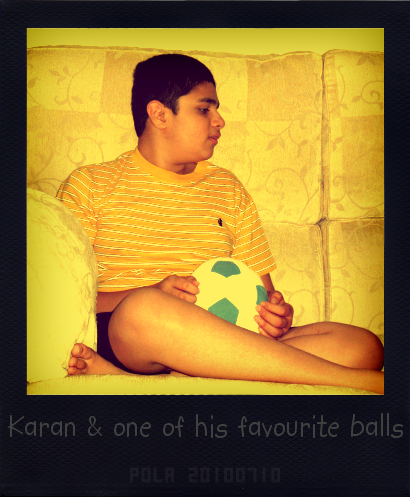
There are many things we take for granted but those very things had to be taught to Karan so that he could understand and do them. I still remember he used to be terrified of playing with balls. The moment I would throw or roll a ball to him, he would start screaming. Devina, my daughter, and I spent hours sitting and rolling and throwing balls to him until he stopped his screams and learnt to play with the ball. And now the ball has become his favourite toy; actually the only toy he loves.

Img_8676_20100731223345_pola

He was afraid of strangers, of going into a shopping mall as he could not tolerate the noise and the crowd. He is still wary of crowds and gets irritated with the noise but now manages to walk around a mall or supermarket for about an hour. He goes to a special needs school and it has helped him blossom. I get a little afraid to take him anywhere too crowded because if he gets upset, he has a tendency to grab my clothes. I am used to this but if he grabs somebody else, I don’t know how they will react. I suppose it would be normal for them to be upset so I prefer not to take a chance.

Also, having a child with special needs has really shown me what people are like. People can be very cruel and hurtful. No one can know my pain or understand it when they dont go through it themselves. I am just trying to do all I can to protect my child from them and frankly speaking, don’t want to have anything to do with such people. And it’s not only strangers who can be cruel but also people you know. And then there are those people – strangers and acquaintances who are so kind and supportive that they renew your faith in humankind.

Karan did not understand how to chew his food; he would just swallow and then choke if the morsel was big. I had to mash his food and feed him. The day he finally understood how to chew and eat with a spoon on his own was a great achievement for us and we could not stop shouting with joy. Of course even now he does swallow rice but chews any finger-food like grilled pieces of chicken or french fries or biscuits.

He was afraid of sudden loud noises…still is but does not react the way he used to earlier. I remember when he was just 3 or 4-years-old and I was walking on the road with him in my arms, a car passed by honked loudly. He was so terrified that he pushed his face into my shoulder and sank his teeth into it and bit me really hard. I could not scream as I did not want to scare him so just kept quiet until he let go. My shoulder was so painful and I had a real beauty of a scar …all black and purple…for a few weeks. Nowadays if he hears a sudden noise, he just grabs my clothes if he is near me, I guess just to feel secure.

I am amazed at his capacity to just love us unconditionally. He has taught me so much. Patience…a virtue I had very little of. How to be strong in the face of adversity, how to be resilient, how to just love, love and love. I am glad he is in my life and would not want to change him for anything. He is my life and I do want him to improve and be able to take care of himself  and I hope that one day he will.

Dealing with an autistic sibling

When they told me Karan had autism … I didn’t know what it meant. I was only 13-years-old and they could’ve been telling me he was left-handed for all I knew (Karan seems to be ambidextrous though). Even months later, it didn’t make much sense to me. All I knew was: he was different.

I resented it for a while. I had been the only child in the house till I was 9. Then a new baby came in and it seemed as though he never grew up; he never moved on from being a child who needed constant attention. At the age of 13, which is when he was diagnosed, it was as if I was told: ‘Hey, you had your Mom till you were 9. That’s it. She can’t pay attention to you anymore.’ Instead of Karan growing up and Mom giving both of us some attention, I felt then, wrongly, that it was all about him and I didn’t matter anymore.

The resentment lasted a few months, sadly enough. I wish it had never been there, but there you go. I grew up in some aspects faster than I should have I think, had he not been autistic. 

There isn’t anything of the sort now. Karan is my darling, the apple of my eye.

It’s hard enough as it is for a kid for deal with the arrival of a new baby in the family – it means you’re not the baby of the house anymore. Handling a sibling with some kind of special needs is a slightly different ball game. I think it depends on how you’ve been brought up, as well as your individual desire to be a part of your sibling’s life.

I must confess, I wanted a sister when my mother was pregnant. I got a brother. I imagined a brother with whom I’d have stupid fights. Instead, I got a brother who is intent on picking up my stuff and breaking them.

You know what?

I wouldn’t have it any different. I know better now.

The day my son was diagnosed with autism

Guest post by Adita Divecha, Karan’s mother

I still remember the day my son, Karan, was diagnosed as autistic. Until that point, I had never heard of that word.

Karan’s developmental milestones were already delayed. He had sat up late, started walking late and at the age of one-and-a-half only babbled. I was a little worried but most people said that boys usually passed their milestones later than girls. At the age of two he had suddenly stopped looking at us, did not respond when we called to him and had started this funny ritual of running in circles, flapping his hands.

At this time, we were also looking to put him in a nursery school. The lady there who took our interview suggested that we get him checked by a doctor who specializes in developmental disorders. She said this because he was not responding to her and was being hyperactive and screaming and running around flapping his arms. Actually I felt she was a little rude in the way she was talking…she did not seem concerned…she just seemed rude.

So we went to Mumbai, India to see a doctor who specialized in developmental disorders when Karan was two-and-a-half. This doctor was one who was so busy that one had to take an appointment months in advance. Anyway we finally got to see him and he looked at Karan who was busy running around the room flapping his hands. I think we were there just for about 15-20 mins and the doctor said that he felt the child was definitely ‘autistic’. He explained a little what that meant and asked us to get a few tests done and we had to come back to him after we got the results.

So that started the tests…cant remember all of them…it was such a long time ago…but there were blood tests, EEG, Fragile X and some others.The Fragile X test was to see if his X chromosome was faulty…to see if he inherited his autism from his mother. Thankfully that was negative. I say “thankfully” because usually in our Indian society, people are very eager and happy to blame the mother if anything is wrong with the child.

After we went back to the doctor, he confirmed that Karan was on the autism spectrum but since we were based in Dubai, he suggested we get him assessed and diagnosed by a doctor there.

I had never heard of “Autism spectrum disorder” before. What I gathered from the doctor was that it was a lifelong situation which could only be helped with therapy and medication. It was a shock as I did not know how to react. I was confused and angry at the same time. Why did it have to be my child? But there was no answer.

But when I look back on those days, I realise that I never cried in front of anyone even though my heart was bursting with this enormous amount of pain. I have this habit of crying alone in the bathroom and showing the outside world what a strong person I am. All nonsense of course.

Anyway, all I knew was that we had to do all we could to help Karan come out of his shell and I was going to do it to the best of my ability.

Autism – a collection of unique disorders?

Note: As always, the work I do for my journalism portfolio for my MA Magazine Journalism course at the University of Sheffield are uploaded here. This one is my 300-500 word piece for the JNL6024 module in the spring semester. It says “Cognition reports” in the sell because as part of the module, we had to create a dummy magazine. Mine was called Cognition and was meant to be a magazine for parents who have special needs children. I’ll be uploading the designed spreads for my other pieces later on.

Electric signals sent by the brain may carry messages that could provide clues to the roots of autism, a Sheffield University psychologist says. Cognition reports.

The autism spectrum may not be a spectrum at all. Instead of a range of related disorders, Elizabeth Milne suspects the links are not as close as previously thought.

“Variations of autism – and what were assumed to be different aspects of autism – are perhaps a collection of unique disorders,” Milne, a leading researcher, said.

Autism is traditionally diagnosed on the basis of social impairments, but Dr Milne is trying to prove the importance of sensory impairments toward understanding the finer aspects of the disability.

“While sensory impairments can be recognized in some subjects, it was never universal. That seems to imply sub-types of autism, which to me is an interesting approach.” 

Autism does show variation between those affected by it – some have a higher IQ than others; some are verbal while others are not. 

Therefore, Dr Milne’s hypothesis could lead to interesting results with regard to future diagnosis.

She said: “My research focuses on sensory types of impairment that we often overlook when diagnosing autism. I really want to whether these impairments affect everyone who has autism or just some of them, and how it affects their daily lives.”

Dr. Milne is currently designing a large-scale study with a greater degree of testing measures in the field of motion perception in order to further explore her concept of autistic sub-types.

She is also using the method of measuring electric signals emitted by the brain upon the presentation of a stimulus so as to map the brain process of an autistic person.

She hopes to start recruiting participants in the next six months, with a testing sample of 40 autistic children and 40 in the control group.

Apart from publishing her findings and speaking about them at medical conferences, Dr. Milne is keen to explain to the people who participate in her study, what the aims of the research are and whether or not they have been achieved. 

“I want to feed back the information I garner from my research to the people who participate and make it clear to them. Most people would not understand medical jargon, so I would like to make results of my study accessible to everyone.”

My brother is autistic; what’s your excuse?

[My 800 word piece for my magazine portfolio submitted last semester]

Labels are meant for jars, not people. With the words ‘mad’ and ‘retarded’ already accepted forms of insults, is the word ‘autism’ not far away from the dubious honour?


A copy of the sign I made for an autism walk in Dubai

When France’s European Minister Pierre Lellouche said that the Tories had castrated UK’s position in Europe by adopting an autistic approach and that they have a bizarre sense of autism, most people were debating about the ramifications of UK’s stand on the issue. A smaller minority expressed outrage about Pierre Lellouche’s use of the word ‘autistic’. I was one of them.

If Lellouche had called the Tories ‘homos’ or ‘niggers’, there would have been an outcry. So how did he manage to call the Tories ‘autistic’ by way of insulting them and get away with it? It doesn’t matter why he did it; his behaviour was inexcusable.

Too often people use disabilities as an abusive way of insulting the so-called normal human beings. A few years ago, my family and I were in a restaurant, my then 4-year-old autistic brother started crying and refused to calm down. A patron sitting at the next table looked over and said very loudly: “What’s wrong with these people? If they have retarded children, they should keep them at home.” Then we were asked to leave the restaurant by the management because ‘the other diners were getting disturbed’. It hurt. It hurt because my brother is not retarded. He, like thousands of other people has an autistic spectrum disorder. It also hurt because it was acceptable then (and still is) to insult someone by way of calling them ‘retarded’ and prevent them from experiencing a routine aspect of life. It’s absolutely abhorrent when one hears the word ‘retarded’ being thrown around as if it were commonplace even in classrooms in secondary schools.

Now it seems ‘autistic’ is the new way of doing it. Since when are mentally handicapped or autistic people not normal? They have a face, two eyes, a nose, a mouth. They look like other human beings. They even feel like everyone else. Being unable to communicate the way the majority of the population does doesn’t give anyone the right to insult them or marginalize the problems they face.

The general public doesn’t seem to have any idea of what autism is outside of Rainman. They think they’ve seen the movie and are therefore experts. Not every autistic person is a savant (a genius in some areas), not every autistic person knows how to wear their clothes themselves and not every autistic person can talk.

For me, autism is about the constant effort to wean my brother out of diapers at night. It’s about teaching him how to wear his shoes. It’s about helping him brush his own teeth. It’s about trying to teach him to do something as simple as imitate other people. The public haven’t got the first clue about the reality of autism. Until you’ve lived with autism or worked in the field, you ain’t seen nothing.

Which is why perhaps, it is not surprising that the public did not raise an outcry against the use of the word as an insult by Lellouche. One wonders if newspapers, in using his quote as their headline, inadvertently made it more acceptable to insult others similarly. I fear that, right now, people would find it perfectly normal (there’s that word again) to say: “You’re so autistic!” and mean it in a hurtful way. But I wouldn’t, in the middle of a fight, use it to be derogatory towards the other person. Because it isn’t.

Families dealing with autism did speak out about this in public forums. One father mentioned in a letter to a newspaper how his 11-year-old autistic son, who could read, had spent years building up a sense of self-esteem, knowing he was not like everyone else. The father in question threw the newspaper that used the quote as a headline before his son could see it. It is unimaginable how an autistic person would feel, reading such news and knowing that Lellouche used their condition as an insult. As if they already didn’t have enough to cope with, now their very being is deemed to be a matter of ridicule?

As for me, I didn’t have to protect my brother; he can’t read. Also, it helps as he lives in Dubai and the geographical distance meant that this did not make headline news.

Families dealing with autism know all too well that it is not derogatory to be autistic. It doesn’t make your child or you (if you’re autistic) a lesser person. I’ve found that autistic people are kind and prone to unconditional love and forgiveness.

Which is more than I can say for many of the ‘normal’ people out there.